
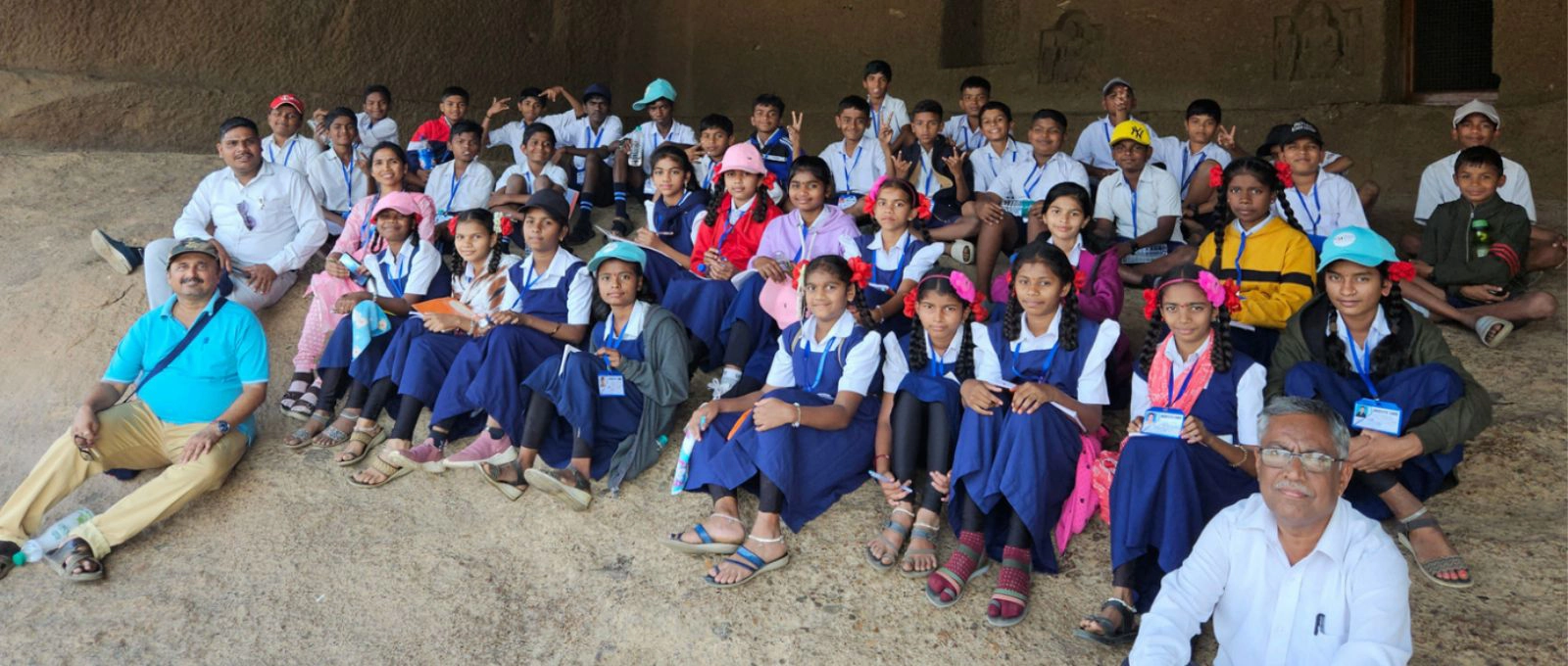

For the students of Grade 6, K J Somaiya Secondary School, Nareshwadi, 15 January 2025 was a day they will never forget. Their one-day Anubhuti programme, curated by the Somaiya Centre for Experiential Learning (SCEL), transported them from their classrooms to the heart of Sanjay Gandhi National Park (SGNP) — a living museum where history, ecology, and adventure blend seamlessly.
The goal was simple yet powerful: to help young learners experience India’s natural and cultural heritage firsthand. Through guided exploration, observation, and reflection, students not only discovered ancient stories carved in stone but also understood the delicate balance between people and the planet.
The Journey Begins: From Forest Trails to Stone Stories
Excitement filled the air as the students boarded the bus early that morning. For many, it was their first trip to Mumbai’s green heart — a rare expanse of forestland surrounded by the city’s urban sprawl. As the bus wound its way through the park’s dense trees, they spotted langurs, monkeys, and herds of deer roaming freely, each sight greeted with gasps of delight.
Their curiosity deepened when they saw small forest quarters — simple homes belonging to park staff and tribal families. The students instantly connected what they saw with the Warli community they had learned about earlier, realising how human life and nature can thrive side by side.
Kanheri Caves: Where Silence Speaks
As the hills of basalt rock came into view, the chatter in the bus faded into awe. Before them rose the Kanheri Caves, a 2,000-year-old complex carved by Buddhist monks. At the entrance, a large site map became the first learning tool — students raced to locate the cave with the highest number carved at its doorway, unknowingly practising spatial mapping and observation.
Led by SCEL facilitators, they entered a world frozen in time. Inside, the cool, echoing chambers revealed ancient viharas (monastic cells) and chaitya-grihas (prayer halls) painstakingly cut into the hills. The simplicity of the monks’ living quarters fascinated the students — stone benches, niches for lamps, and small rooms showed how devotion once shaped daily life.
At the majestic Cave No. 3, the group sat quietly before the stupa, a domed structure symbolising enlightenment. As they chanted the Buddhist verses —
“Buddham Sharanam Gacchami,
Dhammam Sharanam Gacchami,
Sangham Sharanam Gacchami”
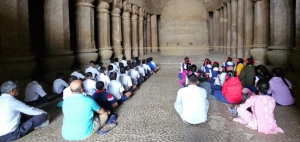 the cave’s acoustics created an ethereal echo. For a brief moment, even the most talkative students were still, their voices blending with centuries of silence.
Throughout the exploration, they spotted ancient inscriptions etched in Brahmi and Devanagari scripts. Guided by information boards, they decoded fragments of history — donors’ names, royal patrons, and stories of trade routes that once connected this region to distant lands. Each discovery brought a spark of understanding: that heritage isn’t just about the past; it’s about the continuity of human imagination and effort.
Heritage, Learning, and Teamwork
In smaller groups, students read aloud from the Archaeological Survey of India boards, summarising information for their peers. This spontaneous “read-aloud” activity encouraged public speaking, teamwork, and shared learning. Some even debated how monks might have spent their days — meditating, teaching, and caring for travellers.
As they climbed higher up the rock-cut steps, the reward was breathtaking: a panoramic view of SGNP’s lush canopy, the distant skyline of Mumbai, and the shimmering dome of the Global Vipassana Pagoda on the horizon. The contrast between the calm of nature and the chaos of the city below sparked conversations about sustainable living and conservation.
From Monks to Big Cats: Into the Wild
After the deep dive into history, it was time for wildlife. The group settled under tall trees for lunch — sharing homemade chapatis, pulao, and fruit in true picnic spirit. Laughter echoed through the forest, turning a simple meal into another moment of bonding.
Next came the much-awaited lion and tiger safari. As the bus rolled into the enclosed reserve, excitement filled the air. The sudden appearance of a Royal Bengal tiger — its striped coat gleaming in filtered sunlight — left the students spellbound. Another tiger lounged lazily nearby, while a majestic lion rested on a bamboo bench, its mane catching the breeze.
The safari was more than spectacle; it was a lesson in observation and respect. Students learned to stay quiet, notice animal behaviour, and understand how these creatures are protected within controlled habitats. The thrill of seeing such magnificent animals up close turned into an appreciation for conservation and coexistence.
Learning in Motion: Cats, Flowers, and Science
The exploration continued at the Cat Orientation Centre, where taxidermy displays and interactive kiosks introduced students to the wild cat family. They pressed buttons to hear roars and growls, tested their knowledge through quizzes, and observed how each species is adapted to its environment. For many, this was the first time biology felt alive and exciting.
The next stop — the Orchidarium — was a burst of colour and wonder. Inside three dome-shaped greenhouses, students discovered how orchids grow in diverse microhabitats. They observed insectivorous plants like pitcher plants in action, connecting directly to their science lessons on plant adaptations. The cool mist, vibrant petals, and scientific explanations created a perfect sensory classroom, blending beauty with learning.
Reflections and Takeaways
As the sun dipped low over SGNP’s forest trails, the students returned to their bus, physically tired but mentally energised. They had travelled through centuries — from ancient Buddhist caves to modern conservation science — all in one day.
Their reflections summed up the spirit of the experience:
“I never knew history could feel this real.”
“Seeing tigers in person made me want to protect them.”
“The caves taught me how simple living can be peaceful.”
The Anubhuti: Sanjay Gandhi National Park programme was not just a field trip — it was a bridge between heritage and ecology, teaching students that learning isn’t confined to classrooms or textbooks. It’s found in echoing caves, rustling forests, and the quiet awe of discovery.
When the bus finally rolled back toward Nareshwadi, filled with chatter and laughter, every student carried home more than memories — they carried awareness, curiosity, and a new appreciation for India’s living history.
Leave a Comment