
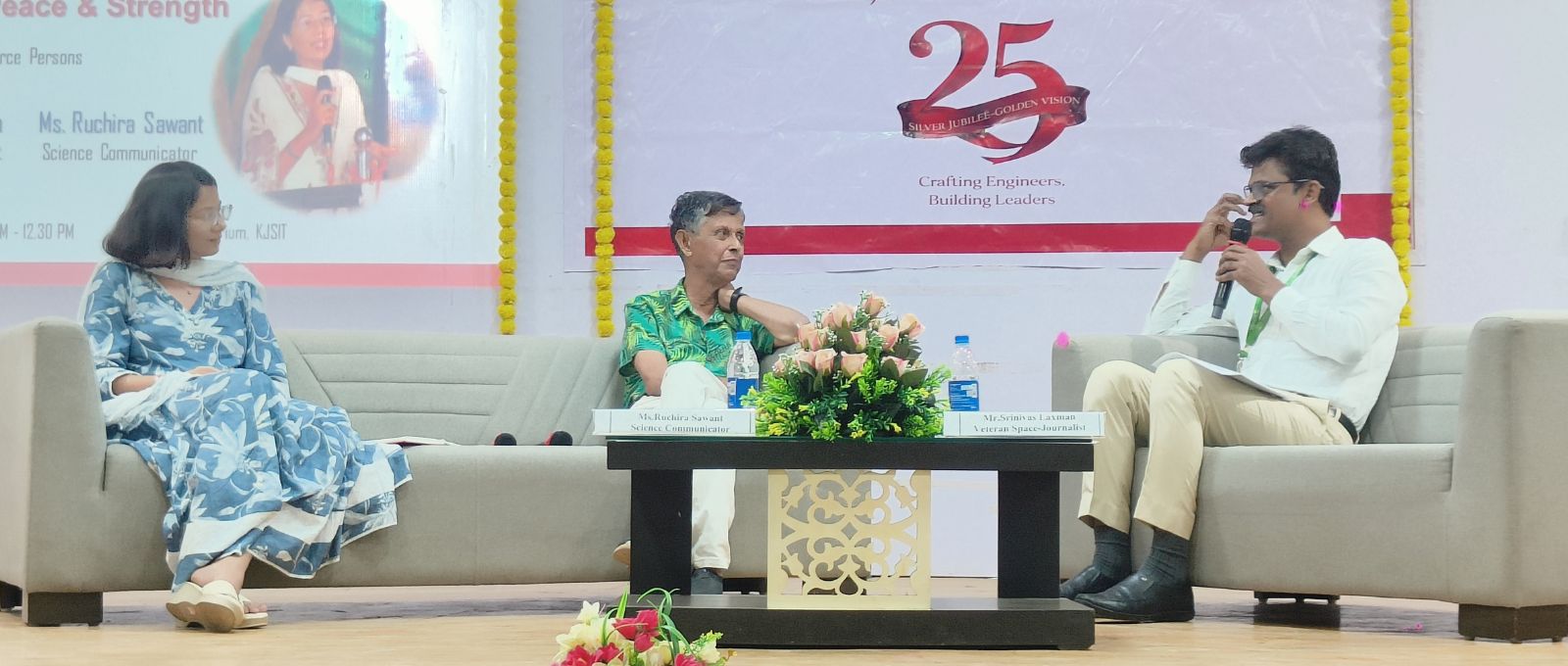

Nuclear. It’s a word that often lands with weight—loaded with fear, politics and uncertainty. But what happens when you strip away the noise and look at it through the lens of science, ethics and national vision? That’s exactly where a recent discourse at Somaiya took its audience.
Held on 2nd April 2026 as part of National Science Day, the session at K J Somaiya Institute of Technology brought together young engineering students for a conversation that felt less like a lecture and more like a shift in perspective. Instead of simplifying nuclear science into binaries of danger versus defence, the discussion opened up its many layers—policy, sustainability, strategy and responsibility.
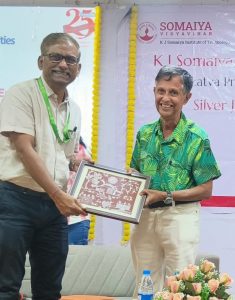 The speakers, Mr Srinivas Laxman, a veteran space journalist, and Ms Ruchira Sawant, a science communicator, brought complementary energies to the room. One grounded in years of storytelling around India’s space and science journeys, the other translating complex scientific ideas into something accessible and relevant. Together, they turned what could have been an intimidating topic into something surprisingly engaging.
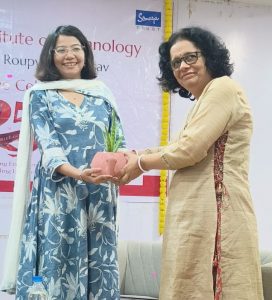 Here’s the thing—what stood out wasn’t just what was discussed, but how it was framed.
The conversation moved beyond textbook definitions into real-world implications. Students explored India’s “No First Use” nuclear policy—not just as a strategic stance, but as a reflection of the country’s ethical positioning. The idea of the nuclear triad and second-strike capability was unpacked in a way that connected defence strategy with long-term stability. And then the lens widened further.
Because nuclear science isn’t just about weapons.
It’s also about energy. Sustainability. Self-reliance. The session highlighted how India is reimagining nuclear energy as a critical pillar of its future—one that balances growing demand with environmental responsibility. References to pioneers like Dr Homi Jehangir Bhabha and Dr Vikram Sarabhai grounded the discussion in legacy, while also pointing towards what lies ahead.
What this really means is that students weren’t just absorbing information—they were being invited to think. To question the narratives they’ve grown up with. To see science not as something confined to labs, but as a force shaping policy, peace and progress.
In a world where “nuclear” is often reduced to headlines and tension, creating space for informed, nuanced conversations is powerful. It replaces fear with understanding—and indifference with interest.
Because the future of science doesn’t just depend on breakthroughs. It depends on how the next generation chooses to see it.
Leave a Comment